Why Is I/O Distributed Outside the BMS Control Cabinet?
In some building automation systems, there is a need to distribute I/O points outside the BMS control cabinet. This is typically related to cabling distances: when the equipment, electrical distribution board, or controlled space is located far from the control cabinet, it is more cost-effective to place the I/O modules close to the equipment and cover the longer distance with a bus or network cable. This reduces field cabling, simplifies installation, and makes future modifications easier.
Distribution in Room Control: Local Control with Multi-24
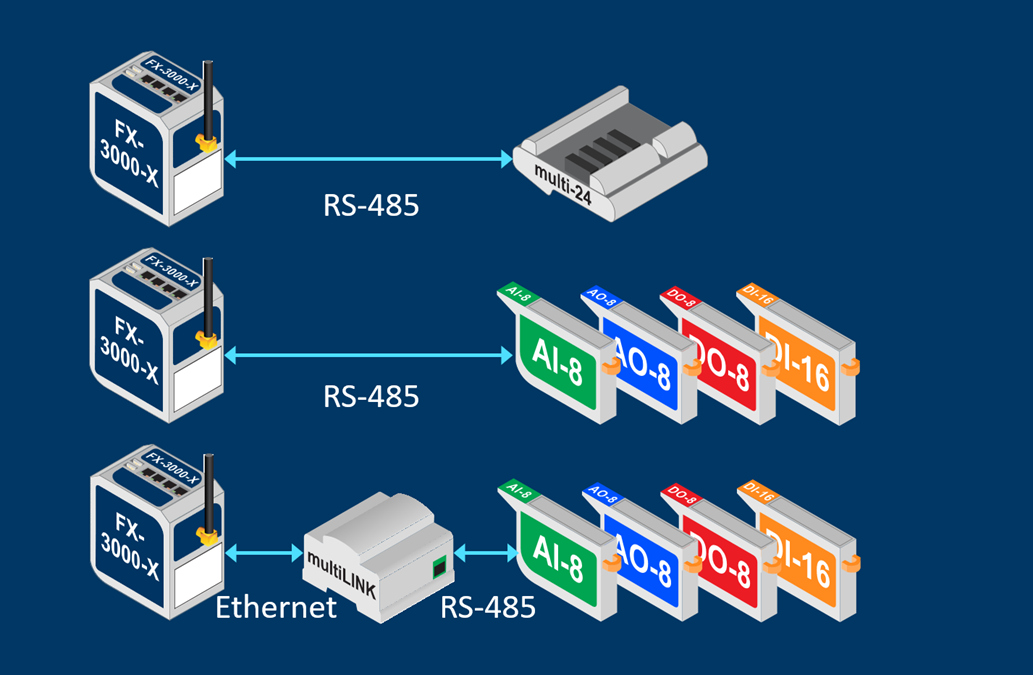
In room control applications, distribution is often implemented so that room-specific control operates independently and maintains its reliability even during communication interruptions. In these cases, the Multi-24 controller is used. Multi-24 is a freely programmable room controller that handles the local control logic and is connected to the central unit via a bus connection.
Cabling Options: RS-485 Bus or Ethernet
In the Fidelix system, distributed I/O can be implemented either with twisted-pair bus cabling (RS-485, for example NOMAK) or with Ethernet cabling. In Ethernet implementations, a Multilink media converter is used, and the I/O module bus is connected to it. When selecting a solution, it is also possible to make use of existing cabling at the site, which is especially important in renovation projects. The image shows examples of implementation methods.
Power Supply for Distributed I/O Modules
When implementing distributed I/O, it must be taken into account that the I/O modules require a local power supply at their installation location. The power supply is typically designed from the nearest electrical distribution board or from the related equipment connection point, and it is dimensioned according to the total load of the modules. At the same time, it is advisable to ensure that the installation location provides suitable conditions in terms of space, protection, and maintainability, and that any power interruptions do not cause uncontrolled situations, but that the system returns to normal operation when power is restored.